
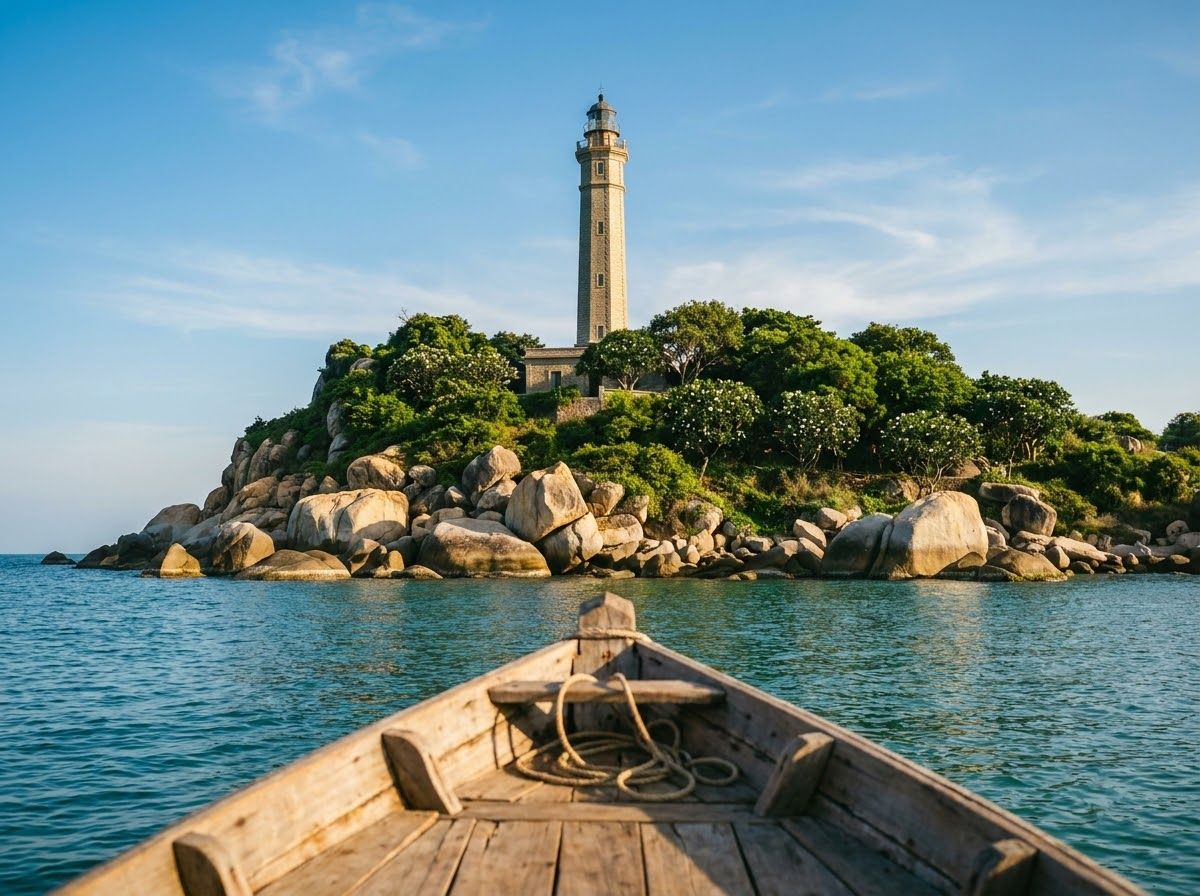
Ke Ga lighthouse is a 42.8-metre octagonal granite tower, finished by French engineers in 1899, on a small rocky islet just off Ke Ga cape on the coast south of Phan Thiet. You reach it by a short boat crossing from the cape, then climb 184 spiral steps for a view over the sea and the coastline. From Sonata Resort at Tien Thanh the cape is about 11 km down the coast road, 15–20 minutes by car.
Plan two to three hours including the boat. It is an easy half-day from Sonata: go early in the morning or late in the afternoon, when the light is soft and the rocks are not too hot to walk on.
What Ke Ga lighthouse is, and why people go
Ke Ga is the tallest lighthouse in Vietnam by the national record book and one of the oldest still working. Construction started in 1897 under French direction; the light was lit in 1900 and still sweeps about 22 nautical miles out to sea. The tower is built from cut granite blocks in an eight-sided shape, with a lantern room at the top and a low stone building at its foot.
The lighthouse has recently been ranked a provincial historic and architectural monument. Most visitors come for three things: the boat ride across, the climb, and the view from the gallery at the top, where the coast curves away to Phan Thiet on one side and La Gi on the other.
| Fact | Detail |
|---|---|
| Built | 1897–1899; working since 1900 |
| Tower height | 42.8 m; the lamp is about 65 m above the sea |
| Shape and material | Eight-sided, granite blocks |
| Steps to the top | 184 spiral steps (some sources say 183) |
| Light range | About 22 nautical miles |
| Status | Provincial historic and architectural monument |
Getting there from Sonata
The cape is south of the resort, so you drive away from Phan Thiet rather than through it. Follow Road 719 along the coast for about 11 km; the turn for the cape and the boat landing is signed in Vietnamese as “Mui Ke Ga” (with accents). Reception can call a taxi or arrange a car with driver, and you should agree a return time before you set off, because cars do not wait at the cape for fares.
The boat crossing
Local boats run from the cape to the islet in a few minutes and wait for you to come back. Life jackets are provided. Fares are charged per person for the round trip and have risen over the years; recent reports range from about 100,000 to 200,000 VND, so ask at the landing before you board. There is also a small entrance fee at the islet, listed at 15,000–35,000 VND per person.
Can you walk across?
Treat the boat as the only way over. The channel between the cape and the islet is open sea, currents change with the tide, and the rocks are slippery. Do not try to wade, even if you see the water low.
When to go
Mornings are best. The sea is usually calmer, the light on the granite is warm, and you finish before the midday heat bounces off the rocks. Late afternoon works too, but check the time of the last boat back. In the windier months from about November to February, crossings can be cancelled when the sea is rough; ask at the landing or have reception call ahead.
| Time | Why | Watch for |
|---|---|---|
| 7–10 am | Calmer sea, soft light, cooler climb | Tour groups arrive mid-morning at weekends |
| Midday | Fewest people on weekdays | Hot rocks and strong glare |
| 3–5 pm | Warm light for photos | Time of the last boat back |
Up the tower and around the islet
The climb is 184 narrow spiral steps inside the tower. It is steep but short; take it slowly and give way on the turns. At the top a gallery runs around the lantern room with views along the coast. Children need a firm hand, and the stairs are not suitable for anyone who struggles with heights or tight spaces.
Back on the ground, the islet is covered in rounded granite boulders shaped by the waves. The rocks at the water’s edge make the classic photo, but wet stone is slippery and waves can surge without warning. Stay on dry rock and keep children well back from the edge.
What to bring
Water, a hat, sun cream and shoes with grip. There is little shade on the islet and only basic drinks stalls at the cape. Bring small notes in dong for the boat and the entrance fee.
Combine Ke Ga with the rest of the coast
Ke Ga sits at the quiet southern end of the Phan Thiet coast. Pair it with a slow lunch on the way back, or with an afternoon at NovaWorld, about 7 km north of Sonata, where there are restaurants and golf. Ta Cu Mountain, with its cable car and reclining Buddha, is inland to the west and makes a separate half-day.
For where everything sits in relation to the resort, see our Sonata location guide, and for the beach and pool back at base, the facilities page.
Questions about Ke Ga lighthouse
How far is Ke Ga lighthouse from Sonata Resort?
About 11 km, or 15–20 minutes by car, heading south along Road 719 from Tien Thanh to Ke Ga cape. Add a few minutes for the boat to the islet. It is the closest landmark to the resort, so a morning visit leaves the rest of the day free for the pool and beach.
How much does it cost to visit Ke Ga lighthouse?
You pay twice: a round-trip boat fare per person, reported at roughly 100,000–200,000 VND in 2026, and a small entrance fee listed at 15,000–35,000 VND. Prices change, so confirm at the landing before you board and carry cash in small notes, as card payment is not usual here.
Can you climb to the top of Ke Ga lighthouse?
Yes, visitors can usually climb the 184 spiral steps to the gallery around the lantern room. The stairs are narrow and steep, so take them slowly, hold children’s hands and skip the climb if you dislike heights or tight spaces. The view takes in the coast towards Phan Thiet and La Gi.
Is Ke Ga lighthouse open every day?
The islet is generally open daily from morning until late afternoon, with no fixed published hours. Boats stop when the sea is rough, which happens more often between November and February. Ask reception to check conditions before you set off, and confirm the time of the last boat back.
Is Ke Ga lighthouse good for children?
For school-age children, yes: the boat ride and the climb are memorable and short. Toddlers need carrying on the stairs and close watching on the wet rocks. Bring water and hats, and go in the morning before the rocks heat up.
Boat fares, entrance fees and distances checked October 2026. Fees change, and boats do not run in rough seas.